
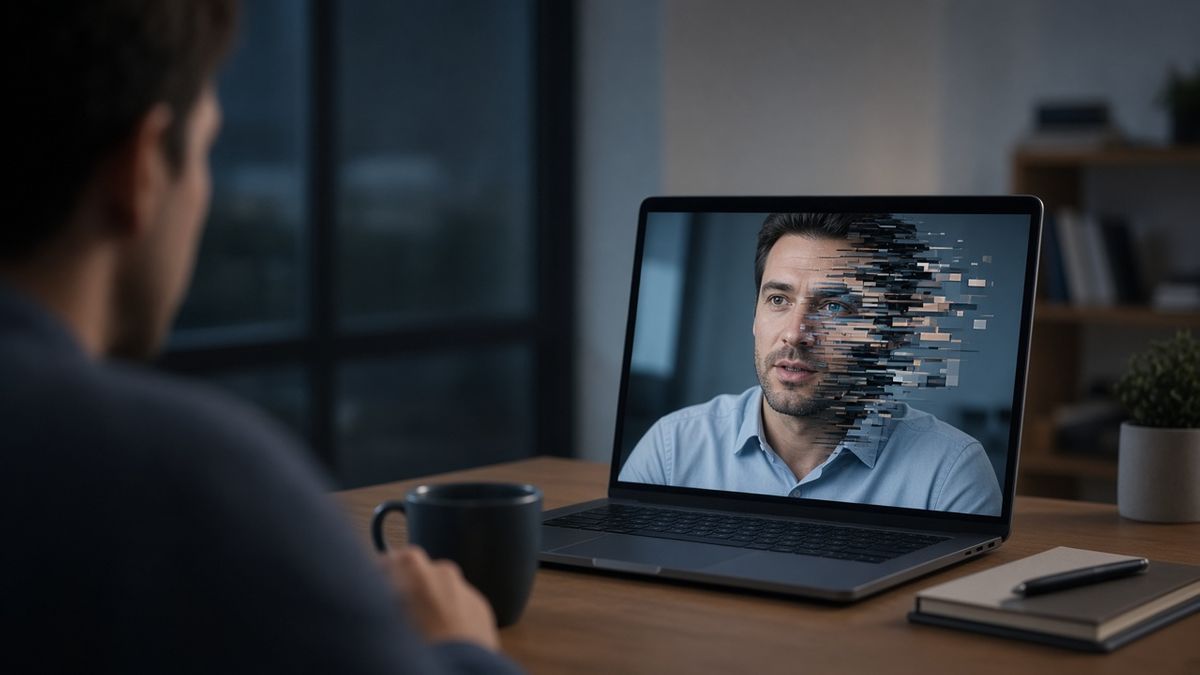
Are You Sure the Person You Interviewed Is the Person You Hired?
By The Riderflex Team
A few years ago, the worst thing a hiring manager worried about was a padded resume. Someone stretched a title, rounded up a tenure, or claimed a skill they had only seen from across the room. Annoying, sometimes expensive, but catchable with a decent interview and a couple of real reference calls.
That is no longer the whole problem. The question some employers now have to ask is more basic: is the person on the other side of the screen actually the person applying for the job?
The numbers are not small anymore
Gartner projected last year that by 2028, one in four candidate profiles worldwide will be fake. In the same research, Gartner surveyed 3,000 job seekers and 6 percent admitted to interview fraud, either posing as someone else or having someone else interview for them. That is people willing to say so on a survey. The real share is unlikely to be lower.
The tools that make this possible are cheap and getting cheaper. Researchers at Palo Alto Networks' Unit 42 showed that one person with no image-editing experience, free AI tools, and an old computer could produce several working fake identities in about 70 minutes.
The result is a strange reversal. Remote hiring made the funnel faster and wider. It also made it easier to fool.
What candidate fraud actually looks like
Most of it is not a cinematic deepfake. It is more ordinary than that.
A candidate interviews well on video, then a different person shows up for onboarding. Someone reads answers fed to them in real time by another person or a tool. A resume lists real companies and real titles that belong to someone else. References turn out to be friends with a script. Occasionally it is more serious: people using stolen identities to land remote roles that come with system access.
For a company hiring a skilled tradesperson who has to show up on a job site, the risk looks different than it does for a remote software or analyst role. But no sector is immune. Healthcare roles carry credentials that have to be real. Technical roles in AI and robotics come with access to systems and intellectual property. A bad hire is expensive. A fraudulent one can be worse.
Why the usual process misses it
Most hiring processes were built to answer one question: can this person do the job? They were not built to ask whether the person exists as described.
Screening calls are short and scripted. Video interviews follow a predictable list of questions, which is exactly what makes them easy to prepare for, or to be fed answers on. Reference checks often go to whoever the candidate supplied, by email, with a form. And in a busy quarter, the hiring manager is relieved to find someone who interviews well and is ready to move.
None of that is negligence. It is a process tuned for a world that has changed.
How to tighten it without slowing to a crawl
The fix is not to make every candidate jump through ten hoops. That chases away the good ones, who have options. The fix is to put friction in the places where a real person has an easy time and a fake one does not.
Make the conversation unscripted. Prepared answers are easy to fake. A real back-and-forth with someone who knows the work is not. Ask the candidate to walk through a specific project they did, then follow the thread. What went wrong? Who disagreed with them? What would they do differently? People who did the work can go three levels deep without hesitating.
Put a senior person on camera early. A senior leader who has done the job notices things a screener will not: answers that sound right but have no texture, a lag between question and response, a person who cannot describe the inside of a place they claim to have worked.
Call references you found, not just references you were given. A former manager you locate through your own network is worth more than three names on a list. Talk to them live, by phone.
Verify identity at a defined step. Match the person on the video to the person on the ID and the person who shows up on day one. Many employers now add an in-person step before an offer for exactly this reason. For trades and healthcare roles, verify licenses and certifications directly with the issuing body.
Watch for consistency across steps. The voice on the screening call, the face on the video, the writing in the follow-up email, and the person at orientation should all be the same human. When they are not, take it seriously.
Where we fit
At Riderflex, every candidate we present has been through a live video conversation with a C-level executive before a client ever sees them. We do that because it is the best way to judge experience, judgment, and culture fit. It also happens to be one of the hardest conversations to fake. A senior operator asking follow-up questions about real work exposes a scripted candidate quickly.
We are a national boutique recruiting firm, which means we take on fewer searches and give each one senior attention. We focus on AI and robotics, skilled trades, and healthcare, the fields where the wrong hire carries real consequences. Our 5-star Google rating across hundreds of reviews comes from clients and candidates who saw that approach up close.
Remote hiring is not going away, and it should not. It widened the talent pool and made good hiring faster. It just needs a process built for the world we are actually hiring in. If you want to compare notes on how other leaders are handling this, the Riderflex podcast and Steve Urban's book are good places to start, or reach out to us directly.
https://www.riderflex.com | 888-964-5876 | info@riderflex.com