
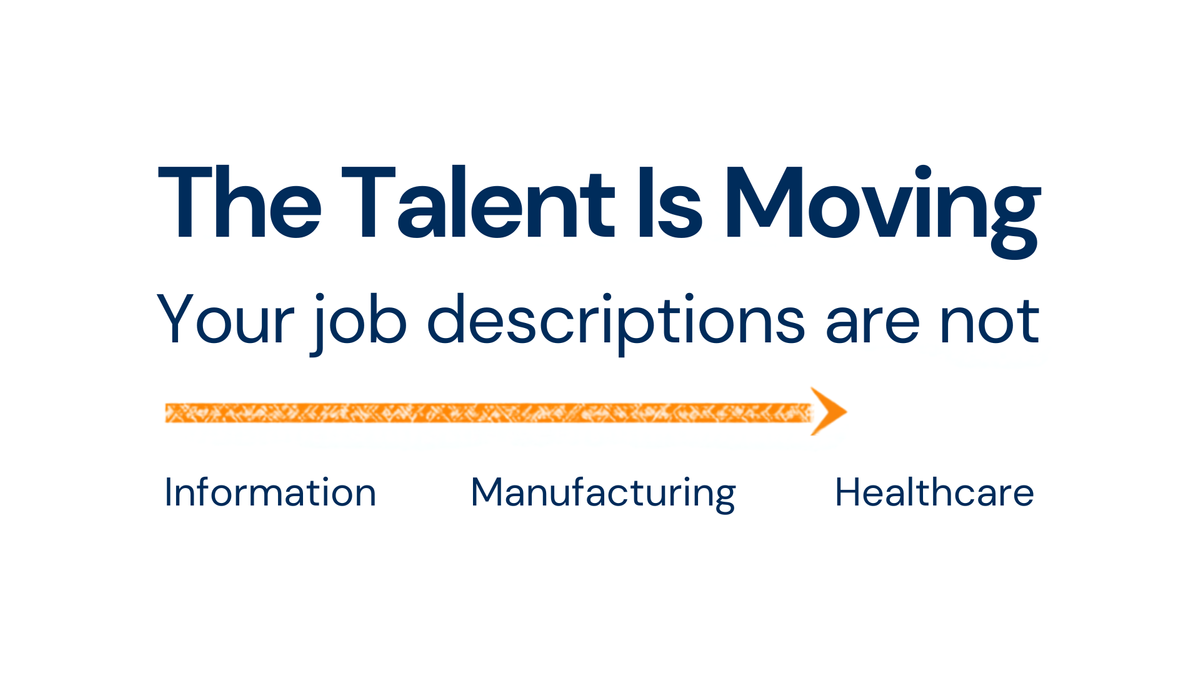
The August jobs report from the Bureau of Labor Statistics had a number in it that most hiring managers skipped past. Employers added 162,000 jobs, and the unemployment rate held at 4.1 percent. Fine. But look at where the jobs moved. The information sector, which includes computing infrastructure and publishing, lost 23,000 positions. Manufacturing added 16,000. Health care added 13,000. Food service added 59,000.
The July JOLTS report, also from BLS, showed the same shape from a different angle. Openings in durable goods manufacturing rose by 76,000 in a month where almost every other category sat still. Hires across the economy ran at a 3.2 percent rate. Quits held at 1.9 percent.
Put those together and you get a labor market that is not tight or loose. It is uneven. Some industries are shedding experienced people while others cannot find enough of them. And the people being let go in one place are, more often than leaders assume, the people who could solve the shortage in another.
The talent is moving. Your job descriptions are not.
Most companies hire from inside their own industry by default. The job posting asks for five years in the sector. The recruiter screens for it. The hiring manager feels safer with a resume that looks like the last three people who held the role.
That default is expensive right now. If you run a manufacturing plant, a healthcare system, or a trades-heavy business, the pool of people with your exact industry background is the pool everyone else in your industry is also fishing in. Meanwhile, a wave of operators, project managers, analysts, and technical leads from the information sector are on the market with skills that transfer directly to your open roles and almost nobody calling them.
We see this at Riderflex every week. A plant needs an operations director. A hospital group needs someone to run a scheduling and logistics function. A robotics client needs a field service manager who can build a team from scratch. The best candidate for each of those roles often did the same work under a different industry label.
What actually transfers, and what does not
Cross-industry hiring fails when leaders confuse two different things: industry knowledge and job competence.
Industry knowledge is the vocabulary, the regulations, the customer quirks, and the specific systems. It matters. It is also learnable, usually in months, by a smart person who has done the job before somewhere else.
Job competence is whether the person can run a P&L, lead a team through a bad quarter, build a process where none existed, and make decisions with incomplete information. That is not learnable in months. Either they have done it or they have not.
A good rule: if a role is mostly judgment and leadership, hire for competence and teach the industry. If a role is mostly technical and regulated, industry background carries more weight, but it still should not be the only filter.
How to vet someone from outside your world
The reason leaders avoid cross-industry hires is not that they doubt the idea. It is that they do not know how to evaluate a resume they cannot pattern-match. Here is what works.
First, interview for the work, not the setting. Ask the candidate to walk you through a turnaround, a hire that went wrong, a process they built. Listen for how they think. The industry they did it in is the least interesting part of the story.
Second, go deep on the transition. Ask what they expect to be different in your business and what they plan to learn first. A candidate who has thought seriously about that gap is a much lower risk than an industry veteran who assumes they already know everything.
Third, have someone senior do the vetting. At Riderflex, every candidate we present has been interviewed on video by a C-level recruiter before a client ever sees them. That step exists precisely for situations like this. A resume cannot tell you whether a former tech operations lead will be effective on a plant floor. A forty-minute conversation with someone who has run a plant floor can.
Fourth, check culture fit harder, not softer. A cross-industry hire is already adapting to new work. Do not add a values mismatch on top of it. Culture-fit matching is not a nice-to-have on these searches. It is the difference between a hire who is up to speed in six months and one who is gone in twelve.
The market will not stay this way
Uneven markets do not last. The information sector will hire again. Health care and manufacturing demand will eventually be met, or it will get priced in through wages. The window where experienced operators from one sector are available and undervalued by another is open now and will close without an announcement.
Leaders who move in that window get a hire they could not otherwise afford and a fresh set of eyes on problems the industry has stopped noticing. Leaders who wait get the same three resumes everyone else is looking at.
If you have a role that has been open too long and the only candidates you see are people who have done the exact same job for a competitor, that is the signal. The talent you need may be one industry over, and it is not going to find you on its own.
Riderflex is a national boutique recruiting firm with hundreds of five-star Google reviews. Every candidate is vetted on video by a C-level recruiter and matched for culture, not just credentials. We work across AI and robotics, skilled trades, healthcare, and executive leadership. If you want to talk through a search that is stuck, reach out.
https://www.riderflex.com | 888-964-5876 | info@riderflex.com